Paul Regan 
A writer’s window to the world of content creation. Flexible interfaces to optimize editorial workflow.
DADI Publish is developed to optimize editorial workflow with flexible interfaces that adapt to your requirements, meaning more time can be spent making content than wasting time managing it. It is built to support the principles of COPE (Create Once Publish Everywhere).
Journalists and editors can seamlessly manage output across multiple products from one place, while engineers can make light work of even complex content collections. Publish currently works with DADI API but our development roadmap will soon allow use with a variety of data stores.
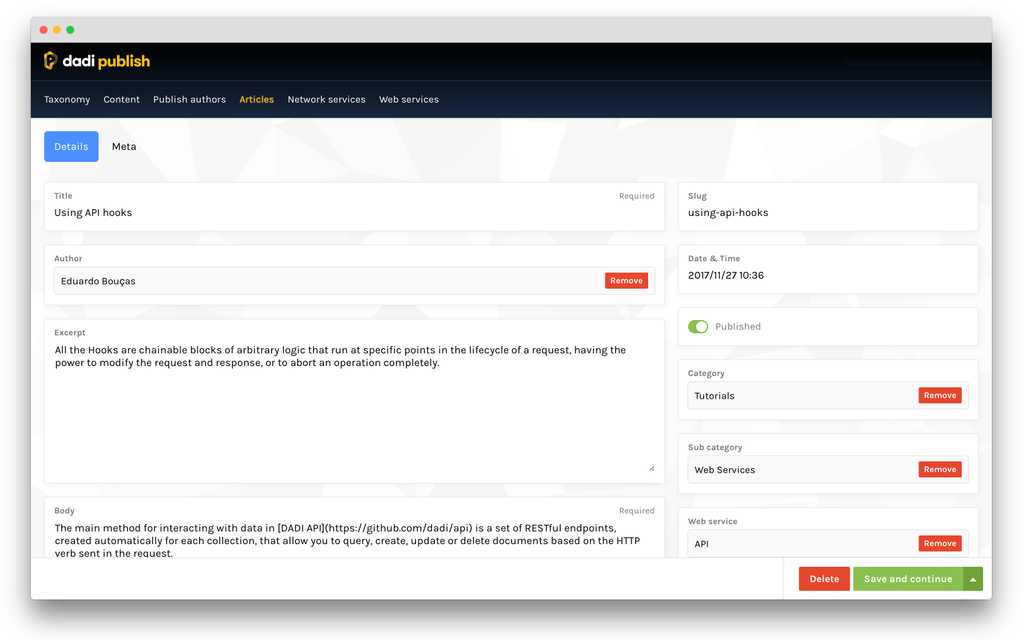
DADI uses Publish to power this site.
Power a suite of digital products from a single content store. Saves time and effort for engineers and editors alike.
Pre-load content for automatic publishing at a time that suits the content, not your working day. Also create drafts for internal review.
The perfect partner for DADI API so you are up and running in days and weeks not weeks and months. Soon to work with other data stores.
Enhanced features for large teams – keeping the right hands on the right parts of the system. Extends to support editorial workflow.
See where colleagues are in shared articles and avoid treading on toes – work together seamlessly to update content.
Provides a complete audit trail allowing you to restore to any point in time. Document differentials provide an overview of changes.


Publish is the content management component of the DADI web services stack, a set of flexible interfaces to easily manage content stored in API.


A cloud storage solution for all types of data, with built-in security, privacy and redundancy.

CRM layer that works with anonymous and known records to make user data directly actionable.

Real-time, streaming data layer providing accurate metrics at individual and product level.

Data visualization for Identity and Track, but capable of taking data feeds from any source.

A machine learning layer that predicts user behaviour based on past interactions.

Taxonomic framework for automated content classification through machine learning.


